Weird Text Generator: Glitched, Flipped, Bubbled and Wide Letters
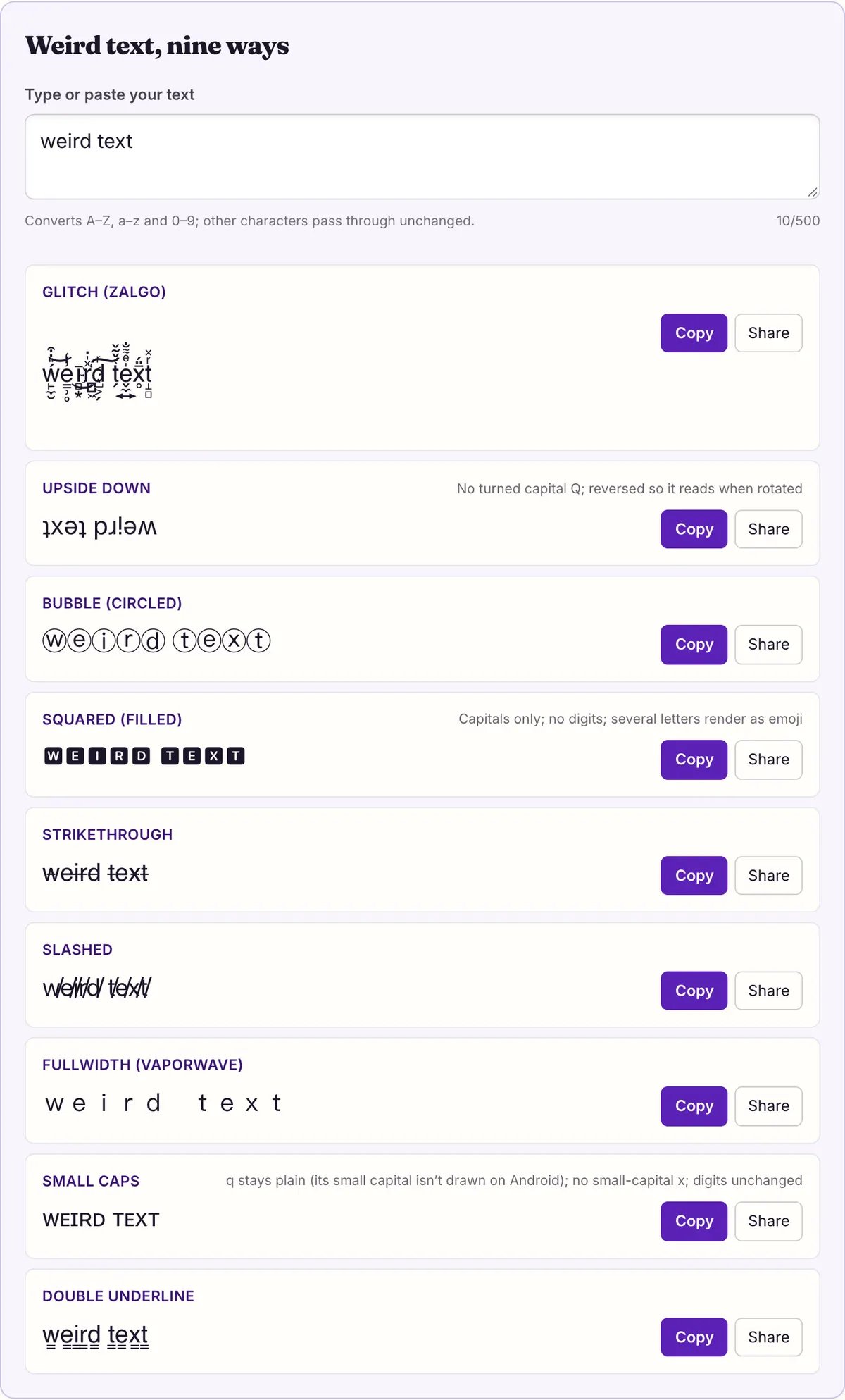
A weird text generator swaps your letters for other Unicode characters: marks stacked on every letter (glitch, strikethrough), turned letters written backwards (upside down), letters inside circles or squares (bubble), and extra-wide fullwidth letters. Type once in the box below and copy any of the nine results. None of it is a font, so it pastes anywhere that accepts plain text.
Weird text, nine ways
No turned capital Q; reversed so it reads when rotated
Capitals only; no digits; several letters render as emoji
Fullwidth (vaporwave)
q stays plain (its small capital isn’t drawn on Android); no small-capital x; digits unchanged
Double underline
The lobby list fills up with names like Player4471 and xX_sniper_Xx, and then one line looks wrong in a good way: ʇxǝʇ pɹᴉǝʍ, upside down, or ẃ̙̼̮̎̇͒͝e̳̹̥̓̒ī̻͙͜r̽̍̇҉̪̺͖d̺͕̗ͬ͠ with marks dripping off every letter. Nobody installed anything to make that happen. A weird text generator like the one above produced it, and the person pasted the result into a name field.
That trick works because every "weird" style is made of ordinary Unicode characters that already exist for other reasons: turned letters for phonetics, circled letters for numbered lists, combining accents for languages that stack diacritics. The generator only picks which characters stand in for yours.
This page sorts those styles into four families, explains how each one is built and where it breaks, and shows what we measured about which phones and Macs can draw them. Each family has its own page with a deeper tool, linked below.
Four families the weird text generator makes
Everything the tool above produces falls into one of four families. They look unrelated, but the family decides almost everything practical: how many characters your text grows to, whether it survives a name field, and what happens when a font is missing.
Here is "weird text" in each family, generated by the same engine that runs the tool:
A weird text generator that mixes these families without saying which is which leaves you guessing why one style survived a name field and another did not. Knowing the family answers that before you paste.
- Combining marks: w̶e̶i̶r̶d̶ t̶e̶x̶t̶ (strikethrough), w̸e̸i̸r̸d̸ t̸e̸x̸t̸ (slashed), w̳e̳i̳r̳d̳ t̳e̳x̳t̳ (double underline) and the glitch style. Your letters stay; invisible-width marks are added after each one.
- Turned letters: ʇxǝʇ pɹᴉǝʍ. Each letter is replaced by a character that looks like it was rotated 180 degrees, and the word order is reversed so it reads correctly with the screen turned over.
- Enclosed letters: ⓦⓔⓘⓡⓓ ⓣⓔⓧⓣ (circled), 🅦🅔🅘🅡🅓 🅣🅔🅧🅣 (filled circles), 🅆🄴🄸🅁🄳 🅃🄴🅇🅃 (squares) and 🆆🅴🅸🆁🅳 🆃🅴🆇🆃 (filled squares). Each letter is swapped for a separate character that already contains its shape.
- Fullwidth letters: weird text. Each letter is swapped for the wide form used alongside Chinese, Japanese and Korean text, which gives the spaced-out "vaporwave" look.
- The outlier, small caps: ᴡᴇɪʀᴅ ᴛᴇxᴛ. These are phonetic letters that happen to look like shrunken capitals. They sit with the weird styles in the tool because they are often used the same way, but they behave like letter styles.
Combining marks stack on top of your letters
A combining mark is a character with no width of its own. The renderer draws it on top of, through or under whatever character came before it. Unicode has a whole block of them, Combining Diacritical Marks from U+0300 to U+036F, mostly so languages can put accents on any letter.
The line styles use one mark each. Strikethrough adds U+0336 (combining long stroke overlay) after every letter, the slashed style adds U+0338 (combining long solidus overlay), underline adds U+0332 and double underline adds U+0333. Spaces are left clean, so the line breaks between words instead of running across them.
The glitch style uses the same idea at full volume. Instead of one mark it picks several at random from three lists, marks that sit above the letter, marks that cut through it and marks that hang below, and stacks them. That is all "zalgo" text is.
Because your original letters are still there, this family is the easiest to undo. If an app strips combining marks, you are left with your plain letters rather than a row of boxes, which is a gentler way to fail than any other family. The glitch page explains how to remove the marks on purpose.
Why upside-down text is a lookalike, not a rotation
No Unicode character means "this letter, rotated". The upside-down style borrows letters that were designed to look turned for other reasons. ɐ is LATIN SMALL LETTER TURNED A from the phonetic alphabet, Ⅎ is TURNED CAPITAL F from Letterlike Symbols, and ꓭ is a letter from the Lisu script that happens to look like an upside-down B.
Where nothing suitable exists, the generator uses a near match or leaves the letter alone. b becomes q and n becomes u, which is close enough when flipped. Letters that look the same either way, like o, s, x and z, stay as they are. Unicode has no turned capital Q, so Q comes through unchanged.
The order matters as much as the letters. The engine reverses the whole string, so "Hello there" comes out as ǝɹǝɥʇ ollǝH. That is why it reads correctly only when you rotate the phone, and why it looks like gibberish if you try to read it left to right. The full lookup table is on the upside-down page.
Enclosed letters and the emoji that sneak in
Circled letters come from Enclosed Alphanumerics (U+2460–24FF), which has circled capitals, circled lowercase and circled digits ① to ⑨ plus ⓪. The filled and squared versions live in the Enclosed Alphanumeric Supplement (U+1F100–1F1FF), and the filled circled digits ❶ to ❾ come from Dingbats.
Not every variant has every character. Filled circles, squares and filled squares exist only as capitals, so the tool converts lowercase to capitals for those styles. Squares and filled squares have no digits at all, so numbers pass through plain.
The surprise is that a few of these characters double as emoji. In our measurement, Ⓜ and the filled squares 🅰 🅱 🅾 🅿 are in Apple Color Emoji and in Noto Color Emoji, the emoji fonts on Apple devices and Android. So a word like 🆆🅴🅸🆁🅳 can show a few letters as glossy red emoji buttons while the rest stay flat. The bubble text page shows exactly which letters do it.
Fullwidth and small caps, the quiet ones
Fullwidth letters are the least weird-looking style but the most reliable. The Halfwidth and Fullwidth Forms block places a wide copy of every printable ASCII character at the original code plus 0xFEE0, so A (U+0041) becomes A (U+FF21). The engine also turns each space into U+3000, the ideographic space, so gaps match the wider letters. Digits and punctuation convert too: "Aesthetic 2026!" becomes Aesthetic 2026!.
Small caps sit at the other end. They come from IPA Extensions, Phonetic Extensions and Latin Extended-D, and two letters stay ordinary: q, because its small capital (ꞯ, U+A7AF) isn’t drawn by Android’s system fonts, and x, because Unicode has no small-capital x. Digits do not change. "Quick fox" turns into qᴜɪᴄᴋ ꜰᴏx, where the plain q and x are the giveaway.
Both styles convert one letter into exactly one character and add nothing on top, so they are the safest picks when a field has a tight length limit or when you want the text to stay readable for people who are not in on the joke.
Will it show up? What we measured
Whether weird text appears for the person reading it depends on their fonts, not yours. If no font on their device has the character, they see an empty box or a placeholder instead. So on 2026-10-27 we read the character map of every system font on macOS 26.5.1 (365 font files) and of the Android system fonts that carry these blocks, and checked every character each style can produce.
The result for the nine styles in the tool above: every character is drawn by at least one font on both platforms. The table counts characters checked and characters drawn. The line styles count as one character each because they add a single mark.
Two limits are worth knowing. We did not measure Windows, because its fonts were not on the measuring machine. And "a font can draw it" is not the same as "an app will accept it": a name field can still reject or strip characters it does not allow.
| Style | Sample | Converts | macOS 26.5.1 system fonts | Android fonts | What stays plain |
|---|---|---|---|---|---|
| Glitch (zalgo) | Ȧ̵̗̟̒̌b̜͈̒̃̎c̩̙͐̅͟ 1̸͔̐̉͊̈2̯͔͎̾́̋3̯̩̓ | A–Z 26/26 · a–z 26/26 · 0–9 10/10 | 101/101 drawn | 101/101 drawn | Nothing — full set |
| Upside down | ƐᄅƖ ɔq∀ | A–Z 18/26 · a–z 21/26 · 0–9 8/10 | 37/37 drawn | 37/37 drawn | No turned capital Q; reversed so it reads when rotated |
| Bubble (circled) | Ⓐⓑⓒ ①②③ | A–Z 26/26 · a–z 26/26 · 0–9 10/10 | 62/62 drawn | 62/62 drawn | Nothing — full set |
| Squared (filled) | 🅰🅱🅲 123 | A–Z 26/26 · a–z 26/26 · 0–9 0/10 | 26/26 drawn | 26/26 drawn | Capitals only; no digits; several letters render as emoji |
| Strikethrough | A̶b̶c̶ 1̶2̶3̶ | A–Z 26/26 · a–z 26/26 · 0–9 10/10 | 1/1 drawn | 1/1 drawn | Nothing — full set |
| Slashed | A̸b̸c̸ 1̸2̸3̸ | A–Z 26/26 · a–z 26/26 · 0–9 10/10 | 1/1 drawn | 1/1 drawn | Nothing — full set |
| Fullwidth (vaporwave) | Abc 123 | A–Z 26/26 · a–z 26/26 · 0–9 10/10 | 62/62 drawn | 62/62 drawn | Nothing — full set |
| Small caps | ᴀʙᴄ 123 | A–Z 26/26 · a–z 24/26 · 0–9 0/10 | 24/24 drawn | 24/24 drawn | q stays plain (its small capital isn’t drawn on Android); no small-capital x; digits unchanged |
| Double underline | A̳b̳c̳ 1̳2̳3̳ | A–Z 26/26 · a–z 26/26 · 0–9 10/10 | 1/1 drawn | 1/1 drawn | Nothing — full set |
Pick a family for a name, a post or a joke
Most people who search for weird text want one of three things: a username that stands out, a post or bio line that catches the eye, or a one-off joke in a chat. The family that suits each job is different, mostly because of length limits and filters.
Name fields are the strictest. Discord, for example, limits usernames to a–z, 0–9, underscores and periods, while its display names may include special characters, spaces and emoji, so weird text belongs in the display name. Roblox filters all text and does not publish a list of allowed characters, so the only way to know is to try.
Before you commit to a name, paste the output into the field and check the preview, then look at it from a second device if you can. The tool copies exactly the characters shown, so what you see in the preview is what the app received. If the app quietly drops part of it, switch families rather than styles: a weird text generator style from the same family will usually fail the same way.
| Job | Best family | Why | Watch out for |
|---|---|---|---|
| Game or app display name | Enclosed or fullwidth | One character per letter, so it fits short name limits | Filters with no published list (Roblox); emoji letters in filled squares |
| Discord display name | Any family | Display names allow special characters | Usernames allow only a–z, 0–9, _ and . |
| Bio or post line | Fullwidth, circled, small caps | Readable at a glance | Plain q and x (ꞯ isn’t drawn on Android; no small-capital x) |
| Crossing something out | Strikethrough | Original letters stay readable | Doubles the character count |
| A creepy or chaotic joke | Glitch | Nothing else looks like it | Can spill over nearby lines |
| A message to flip your phone for | Upside down | Reversed order is part of the joke | Q stays upright |
Every page in this section
- Blank Space Copy and Paste
Blank space copy and paste: Hangul Filler, Braille Blank, zero width space and three wide spaces, with code points and which one to try for names or messages.
- Bubble Text Generator
Bubble text generator for circled, filled, squared and filled-square letters you can paste anywhere, with the letters that turn into color emoji on phones.
- Glitch Text Generator
Glitch text generator for zalgo, cursed and creepy text. See how combining marks stack above, through and below letters, why they spill, and how to strip them.
- Strikethrough Text Generator
Strikethrough text generator that crosses out text with Unicode marks, plus when to use Discord’s ~~ or your editor’s own strikethrough instead.
- Upside Down Text Generator
Upside down text generator that flips and reverses your text, plus a full lookup table of every turned character it uses and the letters Unicode can't flip.
Questions people ask
- Is weird text a font I can install?
- No. Every style is a set of Unicode characters that already exist, so there is nothing to download. That is also why it pastes into places that never let you choose a font.
- Why does my weird text show as boxes for some people?
- The reader's device has no font containing that character, so it draws a placeholder. On macOS 26.5.1 and Android's system fonts we found every character from these nine styles drawn by at least one font. We did not measure Windows or older devices.
- Why does weird text use up my character limit so fast?
- Combining styles add a mark after each letter, so strikethrough doubles the count and glitch text can add many marks per letter. Fullwidth, circled and squared styles swap one character for one, so they are the better choice when a field has a tight limit.
- Can I search for a name written in weird text?
- Usually not reliably. w and ⓦ are different characters from w, so a plain-text search may not match a fullwidth or circled name. Keep a plain version of anything people need to find.
- Which weird text style is the most readable?
- Fullwidth and circled letters, because each letter keeps a clear shape. Glitch text is the least readable by design, and upside-down text only reads correctly when rotated.
- Why are some letters left unchanged?
- Either Unicode has no character for them in that style, or it has one that phones can’t draw. There is no turned capital Q, no small-capital x and no squared digits; the small-capital q exists but Android’s system fonts don’t draw it. In each case the engine keeps the plain character rather than inventing one.
- Why do some letters turn into red emoji?
- Ⓜ and 🅰 🅱 🅾 🅿 are also emoji. We found them in Apple Color Emoji and Noto Color Emoji, so Apple devices and Android can draw them as color pictures instead of flat letters.
- Can I mix two weird text styles?
- Some combinations work. You can run strikethrough over fullwidth or circled letters because the mark attaches to any character. Mixing two letter-swapping styles does not, since each one only converts plain A–Z, a–z and 0–9.
Sources & further reading
Read next
- Glitch Text Generator
Glitch text generator for zalgo, cursed and creepy text. See how combining marks stack above, through and below letters, why they spill, and how to strip them.
- Upside Down Text Generator
Upside down text generator that flips and reverses your text, plus a full lookup table of every turned character it uses and the letters Unicode can't flip.
- Bubble Text Generator
Bubble text generator for circled, filled, squared and filled-square letters you can paste anywhere, with the letters that turn into color emoji on phones.
- Blank Space Copy and Paste
Blank space copy and paste: Hangul Filler, Braille Blank, zero width space and three wide spaces, with code points and which one to try for names or messages.
- Strikethrough Text Generator
Strikethrough text generator that crosses out text with Unicode marks, plus when to use Discord’s ~~ or your editor’s own strikethrough instead.
Want every style at once? Use the fancy text generator on the home page.
Sukie · Editor
Sukie edits Fancy Text Styles. Every style on the site is checked against the Unicode Consortium code charts before it is published, and every page names the characters a style cannot produce instead of hiding them.
About this site · How pages are checked · Last updated October 27, 2026
Fancy Text Styles is an independent site. Discord, Instagram, TikTok, X and other platform names belong to their owners and are used only to describe where text is pasted; none of them endorse this site.