
Subscript Generator: Copy H₂O, CO₂ and xₙ as Plain Text
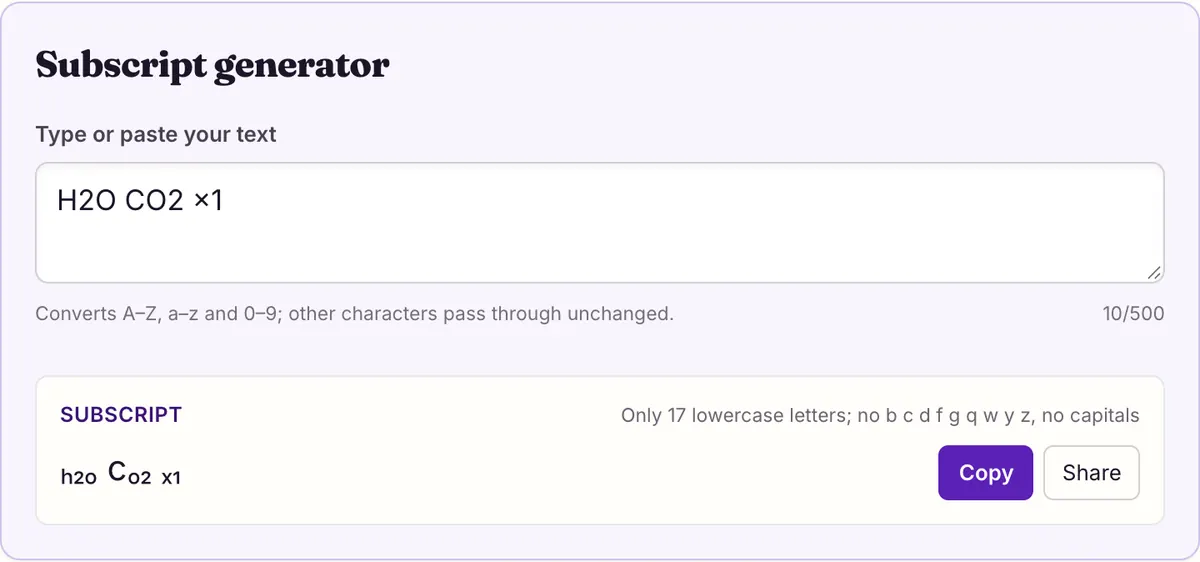
This subscript generator swaps what you type for lowered Unicode characters you can paste into chats, bios and plain-text fields: 2 becomes ₂, so H, ₂ and O give H₂O. All ten digits and + − = ( ) convert, but only 17 lowercase letters do: a e h i j k l m n o p r s t u v x. Unicode has no subscript capitals.
Subscript generator
Only 17 lowercase letters; no b c d f g q w y z, no capitals
17 of 26. That is how many lowercase letters have a subscript form in Unicode, and it sets the limit for any subscript generator, this one included. Digits are complete, ₀ through ₉, so chemical formulas and indexed variables come out well. Whole words mostly do not: the word "subscript" itself comes out as ₛᵤbₛcᵣᵢₚₜ, with a plain b and c stuck on the baseline.
These are not a font. Each lowered character is a separate Unicode character, encoded for phonetics, chemistry and math notation, which is why it survives copy and paste into a profile, a game name or a message box. The same fact explains the gaps: no tool can lower a letter Unicode never encoded. Below are the full map, the formulas that work, every letter that does not convert, and the places where your app's own subscript button is the better route.
Every character, mapped
The grid shows each capital, lowercase letter and digit beside what the generator outputs for it. Where the output is a plain letter, Unicode has no subscript form for it. Read the capital row first, because it behaves differently from what most people expect.
There are no subscript capitals anywhere in Unicode, so the generator lowercases your text before converting it. A capital that has a lowercase subscript comes back lowered and small: H gives ₕ. A capital without one comes back as a plain lowercase letter: C gives c. That is why typing "CO2" in one go returns cₒ₂ rather than CO₂. The fix is in the next section: convert only the numbers.
The lowered characters come from three places in the standard. The digits ₀–₉, the signs ₊ ₋ ₌ ₍ ₎ and the letters ₐ ₑ ₒ ₓ ₕ ₖ ₗ ₘ ₙ ₚ ₛ ₜ sit in the Superscripts and Subscripts block (U+2080–U+209C). ᵢ ᵣ ᵤ ᵥ are in Phonetic Extensions (U+1D62–U+1D65), and ⱼ is alone in Latin Extended-C (U+2C7C). Fonts often draw those blocks at slightly different heights, so a mixed word such as ᵢₙₜ can look a little uneven even though every letter is a real subscript.
The output is one character per input character. A 20-character field still holds 20 characters after conversion, which matters for usernames and display names with a length cap. Spaces and punctuation other than + − = ( ) pass through unchanged, so a slash or a period sits at full height between lowered characters.
The five signs are what make index expressions possible. Typing i-1 gives ᵢ₋₁, typing (n+1) gives ₍ₙ₊₁₎, and typing k=0 gives ₖ₌₀, so a sum's lower limit or a recurrence such as aₙ₋₁ can be written without any formatting. Multiplication signs, commas and slashes have no subscript forms, so an index like i,j stays partly full size; use ᵢⱼ with no comma instead.
Chemistry formulas that come out right
Element symbols are capitals, and capitals cannot be lowered, so a correct formula is built from plain letters plus subscript digits. Type only the number into the generator, copy it, and paste it after the symbol. Every formula below was assembled that way from this page's engine and can be copied as it is.
Charges are the one part this page cannot do. A charge sits above the line, so it needs superscript characters: sulfate is SO₄²⁻, with ₄ from here and ²⁻ from the superscript generator. State symbols are a second trap. Typing (aq) returns ₍ₐq₎, with a full-size q in the middle, because q has no subscript form. Write (aq), (s), (l) and (g) in plain text; a full-size state symbol after a lowered formula is still clear.
Two other notations need both directions. Isotope symbols put the mass number above and the atomic number below, both before the element: carbon-14 is ¹⁴₆C, built from ¹⁴ (superscript), ₆ (this page) and a plain C. Hydrates join two formulas with a middle dot and use a full-size coefficient, as in CuSO₄·5H₂O; only the 4 and the 2 are lowered, and the 5 stays on the line because it counts whole water molecules.
Check the result before you post it. Read it back one character at a time: a digit that did not drop usually means it was typed outside the converted part, and a capital that shrank means the whole formula went through the generator. Pasting into a plain-text note first makes both mistakes easy to see.
- Water: H₂O (type 2, paste between H and O)
- Carbon dioxide: CO₂
- Glucose: C₆H₁₂O₆ (convert 6, 12 and 6 separately, or type "6 12 6" and copy each piece)
- Acetic acid: CH₃COOH
- Sulfuric acid: H₂SO₄
- Sodium bicarbonate: NaHCO₃
- Calcium carbonate: CaCO₃
- Ammonia: NH₃
- Ozone: O₃
- Iron(III) oxide: Fe₂O₃
- Indexed variables in math: x₁, x₂, aₙ, xₙ₊₁ (type n+1 for ₙ₊₁)
- Logarithm base: log₂ and log₁₀ (convert the base only)
- Initial velocity: v₀, with a subscript zero (₀), not the subscript letter ₒ
Nine letters that never drop: b c d f g q w y z
Unicode encodes no Latin subscript for b, c, d, f, g, q, w, y or z, in any block. The generator leaves them as plain letters on purpose. Some converters fill the gaps with characters from other alphabets, and it helps to know what those are before you paste them.
A word converts cleanly only when every letter is one of the 17. Short labels often work: max, min, init, sat, tot, ext and rxn all come out fully lowered, as ₘₐₓ, ₘᵢₙ, ᵢₙᵢₜ, ₛₐₜ, ₜₒₜ, ₑₓₜ and ᵣₓₙ. Common labels that fail include avg (ₐᵥg), cat (cₐₜ), and kcat, written ₖcₐₜ with a full-size c. When a label fails, shorten it to letters that exist, or write it plainly after an underscore, as in k_cat so the meaning stays clear.
Greek is a different story. Unicode does encode five Greek subscripts, ᵦ ᵧ ᵨ ᵩ ᵪ (beta, gamma, rho, phi and chi, U+1D66–U+1D6A), and they are correct when you actually mean the Greek letter, for example a rate constant written with a subscript beta. The problem is only when they are used to impersonate b or y.
- b: some tools paste ᵦ, which is GREEK SUBSCRIPT SMALL LETTER BETA (U+1D66), a Greek letter, not b.
- c, d, f: no stand-in exists in the subscript set; they stay plain.
- g: no subscript g; ᵧ (U+1D67) is Greek gamma, sometimes passed off as g or y.
- q: no subscript q in either case, so state symbols like (aq) cannot be fully lowered.
- w: some tools paste two subscript v's (ᵥᵥ), which reads as "vv" to anyone copying it.
- y: Greek gamma ᵧ is the usual substitute; it is a different letter with its own name.
- z: no subscript z and no common substitute.
- All capitals: none exist, which is why element symbols always stay full size.
Plain text or real formatting? Where each wins
Unicode subscript is for places with no formatting: social bios, display names, comment boxes, chat apps and plain-text forms. In a document editor, real subscript formatting is better in every way. It lowers any character, capitals included, it stays searchable as ordinary text, and it scales with the font size. The table lists the formatting route documented by each app maker, read on 2026-10-27; the subscript shortcut guide has the full Windows and Mac breakdown.
Spreadsheets are the awkward case. Excel can lower characters inside a text cell with its own Subscript formatting, but that does not apply to a number Excel is calculating with. A copied ₂ from this page is plain text in a cell too: it displays fine but will not add up, so keep subscript for labels and headings, never for values a formula needs.
The reverse trap catches people too. Subscript made with formatting exists only inside the document. Copy H₂O from a Word file into a profile field and the formatting is dropped, so the reader sees H2O. That is the moment to use this page: copy ₂ from the generator, not from your document.
On display, we checked all 27 characters this style can output against the fonts that ship with macOS 26.5.1 and with Android, as listed in AOSP's fonts.xml, on 2026-10-27. All 27 were present on both, so readers on those systems should see lowered characters rather than empty boxes. We did not measure Windows, and an app can still strip or block characters in names, so paste a test into the exact field before you rely on it.
Screen readers are the other limit. Each lowered character has its own Unicode name, such as LATIN SUBSCRIPT SMALL LETTER A, and readers differ in whether they announce that name, the base letter or nothing. W3C's WCAG guidance asks that meaning not depend on visual presentation alone, so in anything important, such as a lab instruction or a dosage, also write the formula out in words.
| Where you are typing | Use | How |
|---|---|---|
| Microsoft Word, PowerPoint, Excel | Formatting | Use the app's own Subscript command: the text stays searchable, every letter can be lowered, and screen readers read it normally |
| Google Docs and Apple Pages | Formatting | Use the app's own Subscript command: the text stays searchable, every letter can be lowered, and screen readers read it normally |
| Discord messages | This generator | Markdown Text 101 lists no subscript syntax; its -# subtext styles a whole line, not characters |
| Bios, display names, comments | This generator | No formatting exists, so Unicode characters are the only way |
| Chemistry in a chat or caption | This generator | H₂O, CO₂ and C₆H₁₂O₆ need only digits, which all exist in subscript |
Questions people ask
- Is there a subscript b, c or y?
- No. Unicode has Latin subscripts for only 17 lowercase letters: a e h i j k l m n o p r s t u v x. Characters that look close, such as ᵦ or ᵧ, are Greek beta and gamma. The generator leaves b, c, d, f, g, q, w, y and z plain instead of swapping in a different letter.
- Why did my H turn into a small ₕ?
- The generator lowercases everything first because Unicode has no subscript capitals, and h happens to have a subscript form. For a formula, type only the digits, copy them, and paste them after the element symbols you typed yourself. That gives H₂O with a full-size H and O.
- Will subscript text show up on other people's phones?
- On the systems we measured, yes: all 27 subscript characters are in the fonts shipped with macOS 26.5.1 and Android. We did not measure Windows. If someone sees boxes, their device lacks a font for that character, and writing the formula in plain text is the fallback.
Sources & further reading
Read next
- Superscript Generator
Superscript generator that turns letters and numbers into raised Unicode text like x² and ᵀᴹ, and shows which letters phones can’t draw yet.
- Small Text Generator
Small text generator for small caps, superscript and subscript, with the exact letters each one is missing and how they display on macOS and Android.
- Discord Fonts
Discord fonts to copy and paste for display names, nicknames and messages, checked against Discord's own rules on which fields accept Unicode letters.
Part of Copy and Paste Fonts. Want every style at once? Use the fancy text generator on the home page.

Sukie · Editor
Sukie edits Fancy Text Styles. Every style on the site is checked against the Unicode Consortium code charts before it is published, and every page names the characters a style cannot produce instead of hiding them.
About this site · How pages are checked · Last updated October 27, 2026
Fancy Text Styles is an independent site. Discord, Instagram, TikTok, X and other platform names belong to their owners and are used only to describe where text is pasted; none of them endorse this site.