
Bold Text Generator: Six Bold Styles, Digits Included Where Unicode Has Them
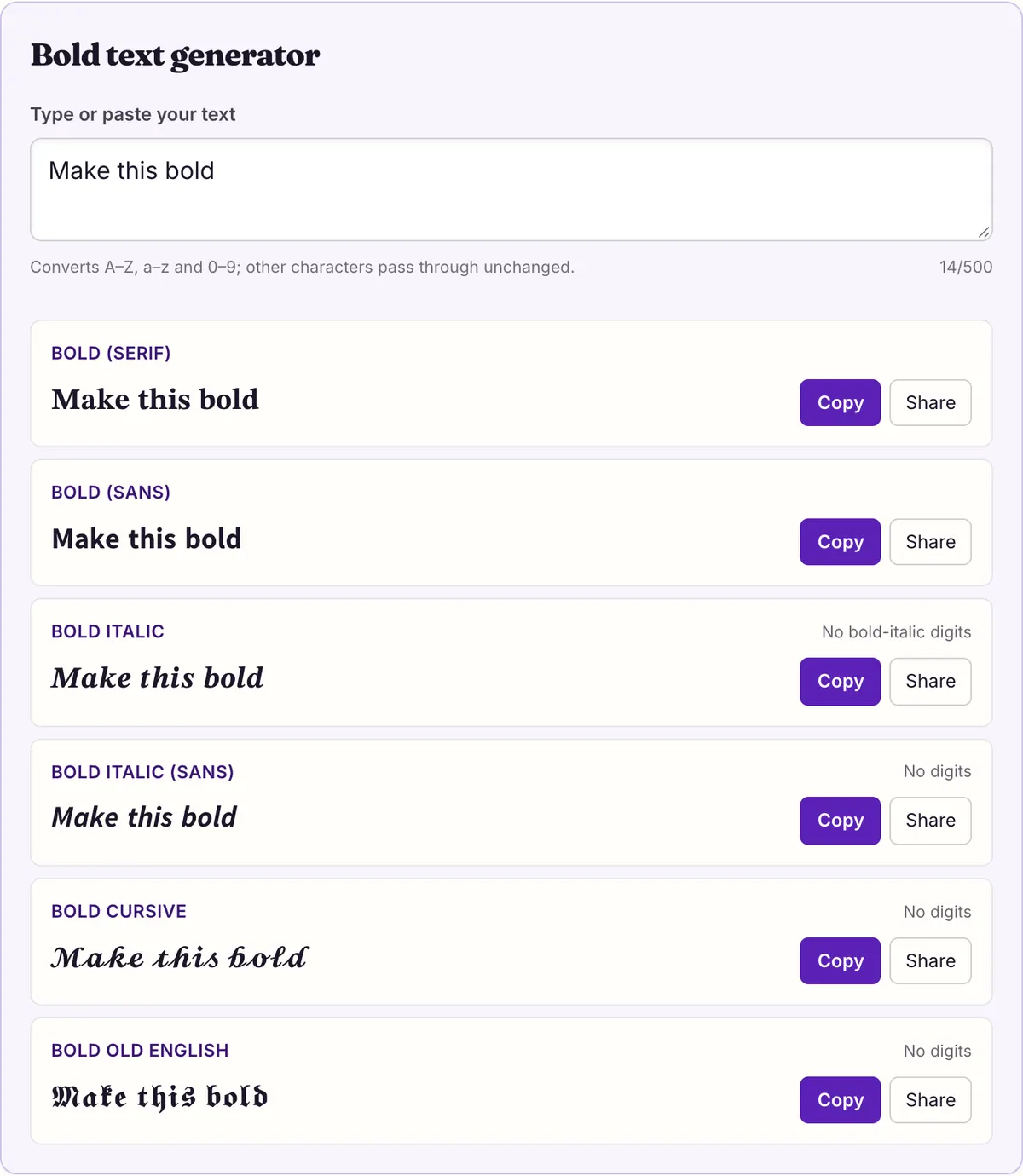
This bold text generator turns what you type into Unicode bold characters you can paste where there is no bold button: posts, bios, display names, comments. Type below, then copy one of six styles. Only bold serif (𝐁𝐨𝐥𝐝 𝟏𝟐𝟑) and bold sans (𝗕𝗼𝗹𝗱 𝟭𝟮𝟯) have bold digits; the other four leave numbers plain.
Bold text generator
No bold-italic digits
No digits
No digits
No digits
Six bold styles, two with bold digits: that is the whole of what Unicode offers, and every bold text generator works from the same set. Bold serif starts at U+1D400 and bold sans at U+1D5D4, and both carry the ten digits. Bold italic, bold italic sans, bold script and bold fraktur cover A–Z and a–z only.
We measured all four main bold styles against every system font on macOS 26.5.1 and on Android: all 62 characters of bold serif and bold sans, and all 52 letters of the two bold italics, are drawable on both.
The tables below show the exact characters, the code points they start from, and where the gaps are, so you can pick a style that fits the text you actually have.
Six bold styles at a glance
Each row below is the same input, "Sale ends 9/30", converted by our engine. The difference in the last column is the one that trips people up: a sale date, a score or a year only turns bold in the first two styles.
The starting code point tells you where the alphabet sits in the Mathematical Alphanumeric Symbols block. A is the first letter of each run, and every other letter follows at a fixed offset, so 𝐁 is U+1D401, 𝐂 is U+1D402 and so on.
Choosing between them is mostly about tone. Bold serif (𝐌𝐚𝐤𝐞 𝐭𝐡𝐢𝐬 𝐛𝐨𝐥𝐝) reads like a heading in a printed book and sits comfortably next to most apps' body text. Bold sans (𝗠𝗮𝗸𝗲 𝘁𝗵𝗶𝘀 𝗯𝗼𝗹𝗱) is flatter and more modern, and it tends to look closest to the bold an app would draw on its own, which makes it the least conspicuous choice for a headline line.
The slanted pair, bold italic (𝑴𝒂𝒌𝒆 𝒕𝒉𝒊𝒔 𝒃𝒐𝒍𝒅) and bold italic sans (𝙈𝙖𝙠𝙚 𝙩𝙝𝙞𝙨 𝙗𝙤𝙡𝙙), work for a single word of emphasis inside a sentence. Bold script (𝓜𝓪𝓴𝓮 𝓽𝓱𝓲𝓼 𝓫𝓸𝓵𝓭) and bold fraktur (𝕸𝖆𝖐𝖊 𝖙𝖍𝖎𝖘 𝖇𝖔𝖑𝖉) are decorative, better suited to a name or a short tag than to anything someone has to read quickly.
| Style | Sample | Capital A at | Bold digits |
|---|---|---|---|
| Bold serif | 𝐒𝐚𝐥𝐞 𝐞𝐧𝐝𝐬 𝟗/𝟑𝟎 | U+1D400 | Yes, from U+1D7CE |
| Bold sans | 𝗦𝗮𝗹𝗲 𝗲𝗻𝗱𝘀 𝟵/𝟯𝟬 | U+1D5D4 | Yes, from U+1D7EC |
| Bold italic | 𝑺𝒂𝒍𝒆 𝒆𝒏𝒅𝒔 9/30 | U+1D468 | No |
| Bold italic sans | 𝙎𝙖𝙡𝙚 𝙚𝙣𝙙𝙨 9/30 | U+1D63C | No |
| Bold script | 𝓢𝓪𝓵𝓮 𝓮𝓷𝓭𝓼 9/30 | U+1D4D0 | No |
| Bold fraktur | 𝕾𝖆𝖑𝖊 𝖊𝖓𝖉𝖘 9/30 | U+1D56C | No |
Every bold serif character, mapped
The grid shows all 62 plain characters next to their bold serif form. There are no dashed cells and no highlighted cells: bold serif is one of the few styles with a complete, unbroken run of capitals, lowercase and digits, and none of its letters had to be borrowed from the older Letterlike Symbols block.
That completeness is why bold serif is the safest choice for mixed text. Punctuation such as the slash in 9/30, commas, hyphens and the at sign has no bold form in Unicode, so those characters stay exactly as you typed them. In practice the plain punctuation is hard to notice next to bold letters.
If you ever need to check a character by hand, the arithmetic is simple. Bold capitals run from U+1D400 (𝐀) to U+1D419 (𝐙), bold lowercase from U+1D41A (𝐚) to U+1D433 (𝐳), and bold digits from U+1D7CE (𝟎) to U+1D7D7 (𝟗). Any character outside those three ranges in a bold serif line is either punctuation or something the generator got wrong.
Bold sans follows the same pattern from U+1D5D4, with its digits at U+1D7EC. Because neither run has a reserved slot, a bold text generator cannot produce the empty-box problem that affects script, fraktur, double-struck and italic. If a bold serif or bold sans letter shows as a box, the cause is on the viewing device, not in the conversion.
Will the bold show on other phones?
The coverage table is our own measurement from 2026-10-27. We read the character map of each of the 365 system font files on macOS 26.5.1 and of the Android system fonts that carry these blocks, and counted how many of each style's characters at least one font can draw.
All four styles came out complete on both systems. That rules out the most common cause of "my bold turned into boxes" on those platforms. We did not measure Windows, so the table says nothing about it, and an app that ships its own fonts can still behave differently from the system.
| Style | Sample | Converts | macOS 26.5.1 system fonts | Android fonts | What stays plain |
|---|---|---|---|---|---|
| Bold (serif) | 𝐀𝐛𝐜 𝟏𝟐𝟑 | A–Z 26/26 · a–z 26/26 · 0–9 10/10 | 62/62 drawn | 62/62 drawn | Nothing — full set |
| Bold (sans) | 𝗔𝗯𝗰 𝟭𝟮𝟯 | A–Z 26/26 · a–z 26/26 · 0–9 10/10 | 62/62 drawn | 62/62 drawn | Nothing — full set |
| Bold italic | 𝑨𝒃𝒄 123 | A–Z 26/26 · a–z 26/26 · 0–9 0/10 | 52/52 drawn | 52/52 drawn | No bold-italic digits |
| Bold italic (sans) | 𝘼𝙗𝙘 123 | A–Z 26/26 · a–z 26/26 · 0–9 0/10 | 52/52 drawn | 52/52 drawn | No digits |
Posts, names and comments: where Unicode bold helps and where it hurts
Bold works best as a signpost: one short line that tells people what a post is about, or a name that should stand out in a list. It works worst where text needs to be found, typed or read aloud.
On sites where the post box has no bold option, Unicode bold is the only way to get bold-looking letters into a post, which is why people ask how to bold a tweet or a Facebook update. The pasted characters behave like any other text in that box: they copy, edit and delete like other text, and they appear on readers' screens in whatever font their device uses for that block.
For names, the rule of thumb is to style the field people read and leave alone the field people type. A display name in bold sans is harmless. A handle or username, if the field accepts styled letters at all, becomes something nobody can type when they want to mention you.
| Place | Good fit? | Why |
|---|---|---|
| Headline line of a post | Yes | One bold line draws the eye; the rest stays readable |
| Display or profile name | Usually | Nobody has to type it; check it on another device |
| Discord messages | Use markdown instead | Discord documents **bold** markdown, which is real formatting |
| Discord username | No | Only a–z, 0–9, underscore and period are allowed |
| Hashtags and keywords | No | Styled letters are different characters from plain ones |
| Whole paragraphs | No | Hard to read and tedious for screen readers |
| Prices, scores, dates | Bold serif or bold sans only | The other four styles have no digits |
Unicode bold vs real bold
Real bold is formatting: the letter stays U+0042 and the app draws it heavier. Unicode bold is a different character, 𝐁 at U+1D401, whose official name is MATHEMATICAL BOLD CAPITAL B. Unicode added it for math, where a bold letter can mean a vector and a plain one a number. Styling a post was never the purpose.
That difference has two practical effects. Search and matching: every math bold letter has a compatibility mapping back to its plain letter, so software that normalizes text will match 𝐛𝐨𝐥𝐝 with bold, while software that compares characters directly will not. Accessibility: a screen reader may announce the formal name, read the plain letter, or skip the character, depending on the reader.
The W3C's guidance on info and relationships asks that meaning not depend on presentation alone. If the app gives you a bold button or markdown, use that. Save Unicode bold for places where there is genuinely no other way, and never put the only copy of important information in it.
A practical middle ground on platforms with no formatting at all: bold only the first few words of a post, the part that shows in a feed preview, and write the rest plainly. The eye still catches the bold line, the body stays searchable, and anyone using a screen reader only has to get through a short stretch of unusual characters.
In a document editor, use its own bold command. Pasting Unicode bold into a document gives you characters the spellchecker does not recognize and that will not change if you later switch the paragraph's font.
Fix bold text that comes out wrong
When bold output misbehaves, the cause is almost always one of these. Work down the list.
Most of these are not bugs in the generator. They follow from what Unicode encodes, what the receiving app does with unusual characters, and which fonts the reader has. Knowing which of the three you are dealing with saves a lot of trial and error with other tools that use exactly the same characters.
- Numbers stayed plain: you used bold italic, bold italic sans, bold script or bold fraktur. Switch to bold serif or bold sans, which have digits.
- Accented letters stayed plain: é, ñ and ü have no math bold form. Unicode's bold alphabets cover only A–Z and a–z.
- The app turned it back to normal: some fields normalize text and replace compatibility characters with plain letters. Use the app's own formatting there.
- A friend sees boxes: their device lacks a font with these characters. We measured macOS and Android as complete, so ask which system and app they use.
- The field rejected it: usernames and handles often accept only a short list of characters. Put the bold in the display name instead.
- It looks uneven: you mixed serif and sans styles. Keep one style per line.
Questions people ask
- Is this a font I can download?
- No. The output is Unicode characters, not a font file. The app you paste into draws them with fonts the reader's device already has.
- Which bold style should I use for numbers?
- Bold serif or bold sans. They are the only two bold styles with digits in Unicode, e.g. 𝟐𝟎𝟐𝟔 and 𝟮𝟬𝟮𝟲. Bold italic, bold italic sans, bold script and bold fraktur have no digits, so numbers in those styles stay plain.
- Can I make text bold on Twitter or Facebook without a converter?
- Posts on those sites are plain text, so the only way to get bold-looking letters is to paste Unicode bold characters like these. Use them for one line, not the whole post.
- Does bold text work in Discord?
- Discord has real bold: wrap text in two asterisks, **like this**, per Discord's Markdown Text 101 article. Use Unicode bold only in your display name, which Discord says may include special characters.
- Why does my bold look different on another phone?
- Each device draws the characters with its own fonts, so the exact shapes differ. The characters are the same; the drawing is not. Bold serif on one system may look slightly heavier or narrower than on another, and that is expected.
- Will a screen reader read bold Unicode?
- It depends on the reader. Some announce the formal character name, some read the base letter, some skip it. Keep essential information in plain text.
- Does it work on Windows?
- We did not measure Windows, so we cannot say. Our measured results cover macOS 26.5.1 and Android system fonts.
Sources & further reading
Read next
- Italic Font Generator
Italic font generator for bios, comments and names: four Unicode italic styles, the correct italic h (U+210E), and why italic numbers don't exist.
- Cursive Font Generator
Cursive font generator with thin and bold Unicode script. See the 11 letters borrowed from an older block, why numbers stay plain, and measured coverage.
- Strikethrough Text Generator
Strikethrough text generator that crosses out text with Unicode marks, plus when to use Discord’s ~~ or your editor’s own strikethrough instead.
- Fancy Text Showing as Boxes
Fancy text showing as boxes? We checked 365 macOS fonts and Android's system fonts: common styles draw fine, but 24 reserved code points never do. Fixes inside.
Part of Copy and Paste Fonts. Want every style at once? Use the fancy text generator on the home page.

Sukie · Editor
Sukie edits Fancy Text Styles. Every style on the site is checked against the Unicode Consortium code charts before it is published, and every page names the characters a style cannot produce instead of hiding them.
About this site · How pages are checked · Last updated October 27, 2026
Fancy Text Styles is an independent site. Discord, Instagram, TikTok, X and other platform names belong to their owners and are used only to describe where text is pasted; none of them endorse this site.